
Opportunity Zones
What are Opportunity Zones?
Opportunity Zones are a community development initiative established by Congress in the Tax Cuts and Jobs Act of 2017 to encourage long-term investments in low-income urban and rural communities nationwide. The Opportunity Zones initiative provides a tax incentive for investors to re-invest their capital gains into Opportunity Funds that are dedicated to investing into Opportunity Zones.
The program was originally set to expire for new investments on December 31, 2026. On July 4, 2025, the One Big Beautiful Bill Act permanently extended the program, amended census tract eligibility requirements, simplified some of the tax benefits, created new reporting requirements, established a decennial redesignation process for eligible census tracts, and enhanced benefits for rural areas. These changes are collectively referred to as ”OZ 2.0.”
Navigation:
To view upcoming or previous events, visit the “+Opportunity Zones in Hawaiʻi Webinars & Seminars” menu in the Resources & Webinars section.
If you are interested in being notified of future Opportunity Zones events please follow this link to sign up.
Opportunity Zones Program
The Federal Tax Cuts and Jobs Act of 2017 authorized a community economic development program called the Opportunity Zones Program. This initiative provides incentives for investors to re-invest realized capital gains into Opportunity Funds in exchange for temporary tax deferral and other benefits. The Opportunity Funds are then used to provide investment capital in certain low-income communities, i.e., Opportunity Zones.
Benefits to Investors
- A temporary tax deferral for capital gains reinvested in an Opportunity Fund. The deferred gain must be recognized on the earlier of the date on which the Opportunity Zone investment is sold or December 31, 2026.
- A step-up in basis for capital gains reinvested in an Opportunity Fund. The basis of the original investment is increased by 10% if the investment in the qualified Opportunity Zone fund is held by the taxpayer for at least 5 years, and by an additional 5% if held for at least 7 years, excluding up to 15% of the original gain from taxation.
- A permanent exclusion from taxable income of capital gains from the sale or exchange of an investment in a qualified Opportunity Zone Fund if the investment is held for at least 10 years. (Note: this exclusion applies to the gains accrued from an investment in an Opportunity Fund, not the original gains).
Additional Incentives
All the Opportunity Zones in Hawaiʻi overlay with other economic development initiatives such as New Market Tax Credits, Enterprise Zones and Transit Orient Development (TOD) Zones. There are also many other non-census tract-based programs that can be applied such as Low-Income Housing Tax Credits (LIHTC). Additionally, there may be synergies between investors and their missions and the major property holders and businesses in an Opportunity Zone.
25 Census Tracts Designated as Opportunity Zones
Hawaiʻi designated 25 census tracts as Opportunity Zones as part of the new federal community development program established by Congress in the Tax Cuts and Jobs Act of 2017 to encourage long-term investments in low-income urban and rural communities nationwide. Its stated purpose is to encourage entrepreneurship and expansion capital for economically distressed areas of the country.
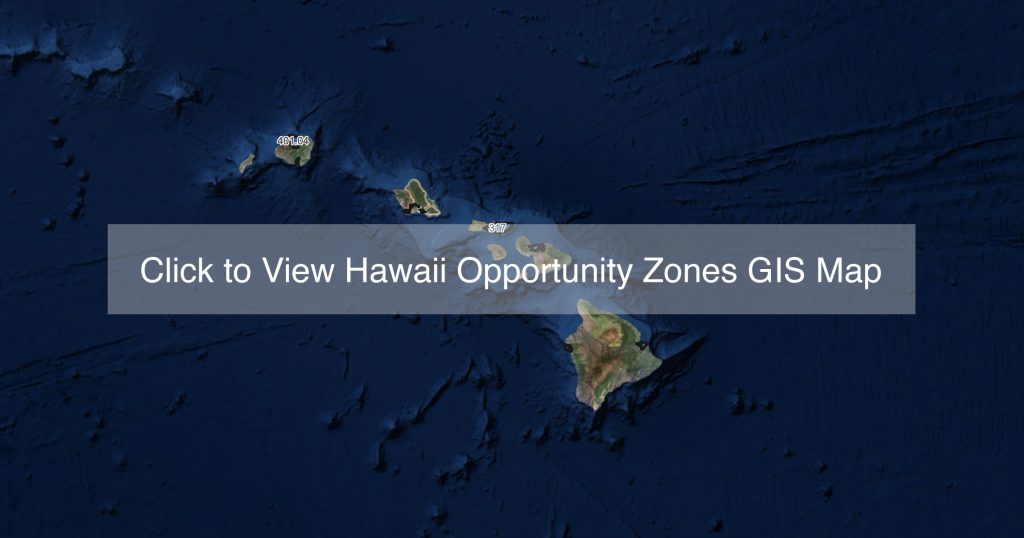
The Hawaiʻi Opportunity Zone's GIS Map
View the interactive Hawaiʻi Opportunity Zones Map
Here is a list of the Opportunity Zones by census tract for the State of Hawaii and downloadable maps by county:
Opportunity Zones 2.0
On July 4, 2025, the One Big Beautiful Bill Act permanently extended the OZ program, amended census tract eligibility requirements, simplified some of the tax benefits, created new reporting requirements, established a decennial redesignation process for eligible census tracts, and enhanced benefits for rural areas. These changes are collectively referred to as ”OZ 2.0.”
What’s new under Opportunity Zones 2.0?
Opportunity Zones 2.0 includes the following updates, with notable implications for how communities plan and engage around OZs moving forward:
- Now it’s permanent. While OZ 1.0 ends in 2026, OZ 2.0 is permanent. Starting January 1, 2027, investments qualify for a rolling five-year deferral—meaning capital gains reinvested at any point can access the incentive without a “use it or lose it” deadline, which can aid investors and communities in longer-term planning.
- New OZ census tracts will be designated. Beginning July 1, 2026, governors will have 90 days (plus a possible 30-day extension) to nominate new OZs. They can select up to 25% of eligible low-income tracts in their respective states. Notably, these designations as “opportunity zones” will last for 10 years. To qualify as “low-income” under OZ 2.0, tracts must have either:
- a median family income at or below 70% of the area median (instead of 80% in 1.0), or
- a poverty rate of at least 20% and median income at or below 125% of the area median income.
This definition means there will be fewer eligible tracts, and that some 1.0 tracts will sunset while others will be newly eligible.
- Investors have stronger incentives for investing in rural communities. Two targeted enhancements create greater incentives for investments in rural areas. The first relates to the “substantial improvement” provision, which is meant to ensure OZ Funds acquiring properties undertake meaningful improvements. OZ 2.0 reduces the requirement from 100% (i.e., investing the equivalent of the property’s basis, excluding land, for renovations or new construction) to 50%. Second, the standard five-year basis step-up increases from 10% to 30% for rural OZ Funds.
- The definition of “rural” also changed to include any place other than a city or town of more than 50,000 residents and any adjacent urbanized area, meaning a significant share of US communities may now qualify.
- New reporting requirements will yield local-level insights. Under OZ 2.0, the US Department of the Treasury will publish annual reports on program scale, investment patterns, and community-level outcomes, along with two deeper socioeconomic assessments during each decade-long designation period. These new requirements give communities and residents more insight into how capital is flowing and whether it aligns with local goals.
(Source: US Federal Reserve)
Key Differences Between OZ 1.0 and OZ 2.0
- Program Permanence: The program was made permanent, and benefits will no longer expire at the end of 2026. Going forward, new OZs will be designated every 10 years, based on updated census data, starting with a new map taking effect on January 1, 2027. This allows for greater certainty, a longer time horizon, and more continuity for investors and communities.
- Census Tract Eligibility: Tracts eligible for designation must have a median family income (MFI) of less than 70% of the MFI for the surrounding metro area; or a poverty rate of greater than 20% AND a MFI of less than 125% of the surrounding area. Furthermore, the OBBBA eliminated the provision that allowed for tracts to be designated if they were immediately adjacent to qualifying tracts.
- Enhanced Rural Focus: The majority of investment in OZ 1.0 flowed into urban areas; Congress included enhanced tax incentives for investing in rural areas in OZ 2.0 to rebalance the landscape. Rural is defined as any area other than a city or town that has a population of greater than 50,000 residents or any urbanized area contiguous and adjacent to a city or town with that population size. Investors in rural OZs are eligible for a 30% step-up in basis at the five-year mark, compared to 10% for non-rural OZ investments. The enhanced rural incentive, combined with the regional nature of housing, workforce, and economic growth challenges and opportunities, should encourage strategic alignment of tract nominations across urban, suburban, and rural geographies.
- New federal reporting requirements will provide clearer, community-level insight into investment activity and outcomes.
Census Tracts Eligible for Opportunity Zone Nomination in 2026
The US Department of the Treasury has published the official list of the 88 census tracts in Hawaii that are eligible for OZ 2.0 nomination. This information may be viewed on their +website.
The Economic Innovation Group (EIG), a bipartisan public policy organization, has created a map of the eligible census tracts may be nominated by governors for designation beginning July 1, 2026.
Other Hawaii census tracts may also be eligible for qualification.
OZ 2.0 Timeline
- July 1, 2026: A 90-day window for Governors to nominate OZ 2.0 tracts opens.
- September 28, 2026: Governors must submit their nominations to the U.S. Treasury Department by this date, with an option to request a 30-day extension.
- By December 26, 2026: Treasury will certify and publish the final list of OZ 2.0 designated tracts.
- January 1, 2027: OZ 2.0 map and new tax rules take effect.
Submit Your Project Information
Governor Green will nominate 25 of Hawaii’s eligible census tracts to become new Opportunity Zones. To assist with the selection process, please provide his office with information about projects happening across the state that could benefit from OZ 2.0 by following this link and filling out the online form.
OZ 2.0 Activation Summit & Seminars
On June 1, 2026, the Opportunity Zones 2.0 Market Activation Summit convened developers, investors, and state and county leaders to prepare for Governor Green’s upcoming nomination of 25 census tracts for designation as new Opportunity Zones. Participants received a comprehensive overview of the major updates in “OZ 2.0,” including new incentives, compliance requirements, and investment pathways, and explored real-world case studies illustrating viable project models and deal structures. National experts in policy, law, accounting, and finance provided guidance on effectively leveraging the renewed program to support housing, energy, and economic development projects across Hawaii.
Factsheets on Hawaiʻi’s Current Opportunity Zones
- Hilo Area – Opportunity Zones Factsheet
- Kona Area – Opportunity Zones Factsheet
- Honolulu Area, Aiea – Waipahu Neighborhoods- Opportunity Zones Factsheet
- Honolulu Area, Downtown – Chinatown – Kalihi Neighborhoods – Opportunity Zones Factsheet
- Honolulu Area, Aloha Stadium – Opportunity Zones Factsheet
- Honolulu Area, Kalaeloa – Opportunity Zones Factsheet
- Kahului Area, Maui – Opportunity Zones Factsheet
- East Molokai – Opportunity Zones Factsheet

Resources
- Economic Innovation Group – EIG is a bipartisan public policy organization addressing America’s most pressing economic challenges.
- Novogradac & Company LLP – Novogradac is a national professional services organization that consists of affiliates and divisions providing professional services that include certified public accounting, valuation and consulting with more than 25 offices nationwide.
- Department of the Treasury, Community Development Financial Institutions Fund – The Community Development Financial Institutions Fund (CDFI Fund) plays an important role in generating economic growth and opportunity in some of our nation’s most distressed communities.
- Council of Development Finance Agencies – The Council of Development Finance Agencies is a national association dedicated to the advancement of development finance concerns and interests. CDFA is comprised of the nation’s leading and most knowledgeable members of the development finance community representing hundreds of public, private and non-profit development entities.
- White House Opportunity and Revitalization Council “Completed Program Targeting Actions” – There are numerous Federal agencies that are offering Opportunity Zone benefits (bonus points, preference points, priority consideration or special consideration) associated with their programs including grants and other funding. Additional resources can be found on the HUD Opportunity Zones website.
Opportunity Funds
The Opportunity Zones program provides a federal tax incentive for investors to re-invest their realized capital gains into Opportunity Funds that are dedicated to investing in Opportunity Zones. Opportunity Funds are the private sector investment vehicles that invest in Opportunity Zones. The fund model will enable a broad array of investors to pool their resources in Opportunity Zones, increasing the scale of investments going to underserved areas. A list of Opportunity Zone Funds can be found at:
Opportunity Zone Fund Directory from Novogradac & Company LLP
IRS Guidance

December 19, 2019, the U.S. Treasury Department and the IRS today issued final regulations implementing the Opportunity Zones tax incentive. Opportunity Zones, created by the Tax Cuts and Jobs Act, offer capital gains tax relief for investments in economically distressed areas.
Opportunity Zones in Hawaiʻi Webinars & Seminars
Previous Events:
Opportunity Zones 2.0 Market Activation Summit – June, 1, 2026
Community Infrastructure Center (CIC) Hosted by The Milken Institute – September 23, 2025
The CIC is a digital platform that helps communities move infrastructure and climate resilience projects from early concept through financing by connecting them to the right funding, technical assistance, and capital providers. Topics covered in this deep-dive session:
- Overview of CIC’s core tools and how they can be applied to OZ projects/projects in Hawaii
- Project Readiness Assessments and how they can be used to help communities prepare
- Funding and financing discovery across federal, state, philanthropic, and private sources
- Curated Deal Rooms for connecting projects with aligned providers
- Reporting and collaboration features that support pipeline management
- What OZ 2.0 could mean for local projects
Hawaii Opportunity Zones (OZ) 2.0 Workshop – August 13, 2025
A virtual Hawaii Opportunity Zones (OZ) 2.0 Workshop that was held on Wednesday, August 13, 2025.
This OZ refresher was a hybrid workshop focusing on positioning the State of Hawaii for the potential enhancements and extension of the existing program. OZs offer tax incentives to investors who reinvest capital gains into Qualified Opportunity Funds (QOFs), which can be used to finance new construction or substantial rehabilitation of housing as well as other benefits. Workshop speakers:
- Brent Parker – Partner, Novogradac (+presentation slides)
- Catherine Lyons – Director of Policy & Coalitions at Economic Innovation Group (+presentation slides)
- Patrick Mullen – Managing Director, Arctaris Impact Investors (+presentation slides)
- Sarah Ortner – Milken Institute (+presentation slides)
Understanding Opportunity Zones – October, 17, 2019
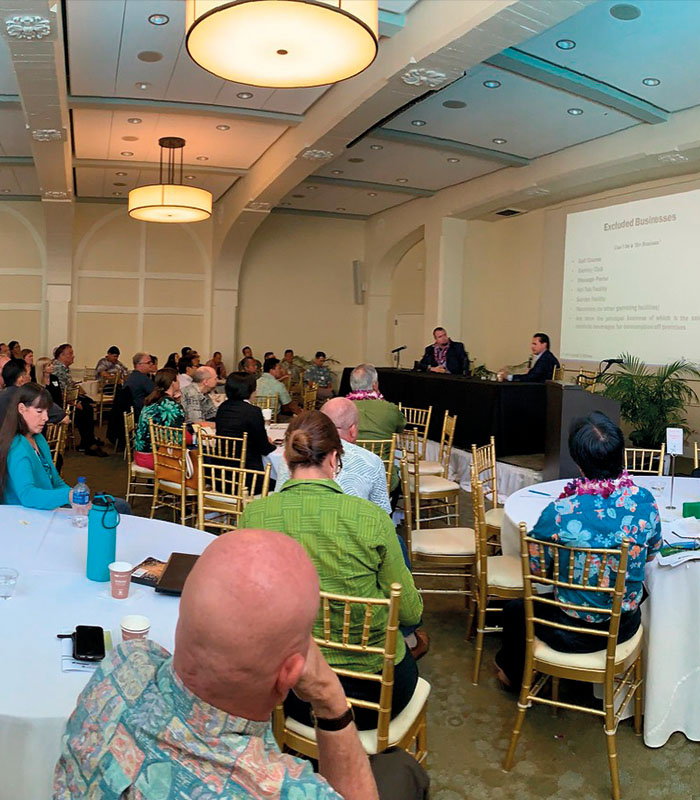
On October 17, 2019 DBEDT and partner organizations, Hawaiʻi Society for Certified Public Accountants (HSCPA) and the Hawaiʻi Community Reinvestment Corporation (HCRC) took a deep dive into the tax, legal and business details of investing in Hawaiʻi’s Opportunity Zones (HI OZ), a community development program authorized by the recently passed Federal Tax Cuts and Jobs Act of 2017. This tax initiative provides incentives for investors to re-invest capital gains into Opportunity Funds in exchange for temporary and long-term tax deferral and other benefits. The Opportunity Funds are then used to provide investment capital to economically challenged communities, i.e., Opportunity Zones. National experts covered all aspects of this federal initiative to direct investment capital into economically challenged areas of the state. This seminar was designed for CPAs, lawyers, bankers, real estate brokers, potential investors, and financial advisors. Also, this seminar addressed many questions of business owners and real estate developers who are considering seeking an Opportunity Fund investment. For more information, please download the program and presentations:
- Update on Understanding Opportunity Zones program
- DBEDT Presentation
- Hawaiʻi Community Reinvestment Corporation Presentation
- Keynote Presentation
- Colliers International Presentation
Understanding Opportunity Zones in Hawaiʻi Seminar – October 4, 2018
On October 4th, 2018 a half day seminar in Honolulu was held titled “Understanding Opportunity Zones in Hawaiʻi.” The event was co-sponsored by DBEDT, Hawaiʻi Community Reinvestment Corporation, and the Federal Reserve Bank of San Francisco.
Almost 200 people attended the event and joined the conversation exploring possibilities for Opportunity Zones in Hawaiʻi. Local and national experts (including Maurice Jones of LISC and a Brent Parker from Novogradac & Company) spoke and focused on what we know so far about how this new tax incentive can be used and the roles regional stakeholders can play to ensure the benefits of this investment vehicle are broadly shared. Here are the presentations:
- Event program
- Opening screen
- Introduction to Opportunity Zones, Local Initiatives Support Corporation (LISC)
- Selecting Opportunity Zones, DBEDT
- Understanding Opportunity Funds, Novogradac & Co LLP
- Plans in County of Hawaiʻi
- Plans in County of Maui
- Plans in County of Kauaʻi
- Plans in County of Honolulu